TeraCom City
In the days before the Blackout, the metropolis of New York City was slowly transformed by the TeraCom Corporation. Month after month, neighborhoods were bought up and reformed to fit TeraCom’s needs. Eventually, TeraCom consumed the industrial districts of Eastern New Jersey. Cities like Hoboken and Jersey City became part of the new forming metropolitan area. The new megalopolis stretched out as far as Hartford, CT to the north and Philadelphia to the south, forming one massive mega-city. It wasn’t long until this new bastion of industrialization was renamed TeraCom City. Lower Manhattan and Times Square saw the construction of lavish skyscrapers that would hold the wealthiest, most elite of TeraCom City society.
When the AI went online, the world was hurled back into the dark ages. Most of the world’s cities had been lost to riots, natural disasters, and the devastation of unmanaged waste left in the wake of humankind’s apathy. Millions died in those following days. TeraCom was able to keep its buildings and factories mostly intact and quickly began to reconstruct its infrastructure. Within a decade the power was back on.
The only problem after that was filling the workforce void left by the devastation. With the help of some new Corvidian partners, 10s of thousands of Org workers were relocated from the Moon to Earth to reinforce TeraCom’s new workforce. TC factories were open for business once again. The old boroughs were repurposed to house the new migrant Org residents.
Lower Manhattan remains as the TeraCom Corporation’s lavish economic center, with elegant high-rise towers reaching into the sky. Harlem’s old neighborhoods were refurbished to house thousands of new settlers but most of the old brick buildings still stand. The large project buildings of the Bronx, once the homes of countless immigrant families, are now the homes of immigrants to Earth from another planet. The old bridges still stand, and much of what was once New York City’s infrastructure still exists, stretching across the city in every direction. In Brooklyn, where diners and delis served hundreds a day before the Blackout. Now, alien food stores serve familiar delicacies courtesy of The Gulraa. Some old subway networks still run, busy and congested as ever, shuttling workers to and from TCC’s industrial plants.
TeraCom City is still ripe with trash, traffic, graffiti, and the brash attitudes you can only expect from a new yorker. Even taxis can still be hailed. You just might want to brush up on your Gruellein before you go day tripping through the resettled boroughs.
Long Island & Staten Island
Still part of the greater TeraCom City economic zone, the suburbs are far from the hustle and bustle of the big city. Both of these areas have managed to maintain stronger resemblances to the pre-blackout USA than most of the surrounding areas.
Long Island specifically has maintained most of its infrastructure and has degraded very little over the years. TeraCom executives that don’t mind commuting to work can still enjoy the peace and tranquility of their quiet coastal neighborhoods.
Staten Island has also maintained most of its structural integrity. However, over the last few decades since the Blackout, there has been a noticeable increase in the borough’s urban decay and trash pile up. The worst accumulation of trash in these boroughs are the TC middle management yuppies. Well-to-do humans that commute from the burbs in their expensive sports cars. They drive passed the squabbling riff raff of the inner-city. From behind their tinted windows, sat on their heated leather seats, they gaze upon the festering rabble and say to themselves, “we’re all in this together”.
Metro Village
Below the bustling streets of TeraCom City, far from the boots of TeraCom Security, is Metro Village. This massive subterranean bazaar is built into the old New York City subway tunnels that were abandoned long before the Blackout.
In the decade prior to the Blackout, the worsening economic conditions of the world led to a sharp increase in the already vast numbers of TeraCom Cities homeless population. Many took shelter in the tunnels to escape the elements. On the night everything went dark, families tried to hide from the riots and chaos. Eventually the improvised underground settlements would grow into what they are today. Metro Village, a beautifully wretched hive of scoundrels and vagabonds.
West TeraCom City ( ☠ Central New Jersey )
Though still technically part of TeraCom City, West TeraCom City is NOT part of TeraCom City’s economic zone. The heart of New Jersey rots far from the central economic zones. The city lights can’t reach the woodland. This area is dark and depraved. Strangely, Central Jersey hasn’t suffered much since the Blackout; it’s always looked like this. Unfortunately for the residents of West TeraCom, most viable employment exists inside the TC economic zones. Residents of Central New Jersey are left to fend for themselves.
The area is practically an urban no-man’s land between the greater TeraCom City economic zone and the extended economic zone of Philadelphia. Though the houses here are technically deedable by TeraCom, most structures are abandoned or inhabited by roving gangs and squatters. The few strip-malls and convenience stores that still miraculously stay open for business, will usually be boarded up with posted signs informing travelers, “I assure you, we’re open!”.
Atlantic City
Though also technically still part of TeraCom City and a TeraCom economic zone, Atlantic City resembles much of the urban blight that plagues the area. Half dilapidated ghost town, one-part crime ridden cesspit, one-part TeraCom incorporated casino, the Jersey Shore has become a toxic waste laden parody of itself.
Despite TeraCom’s involvement, the area is still mostly run by the Delucas, a local mob family that pays tribute to the Violettas. The corruption in this area runs deep. Atlantic City’s TC Security department is staffed by multiple officers who are either affiliated or directly associated with the Delucas.
Detroit
Once the manufacturing hub of the Midwest, during the Blackout, much of the city was destroyed. After the power came back on in TeraCom City, it didn’t take long for the TeraCom Conglomerate to set its eyes to the west. Like true frontiers of the new millennium, TeraCom shuttled out Org workers to rebuild the city and security forces to keep the raiders at bay. Within a few years, the factories of Detroit were operational, and this vibrant staple of Americana was bustling again. The old GM Renaissance Center became TeraCom’s Midwestern headquarters and theoretical hub of the city once more.
Buses, cars, trucks, and scavenged wasteland vehicles can be seen fighting through traffic, carrying people to work. Across the Midwest, families who survived the Blackout come to Detroit to rebuild. People look to this old city with hope. Roving gangs, violence, and poverty are still as common as the container ships hauling toxic waste in and out of the city, just like before.
The Sovereign States
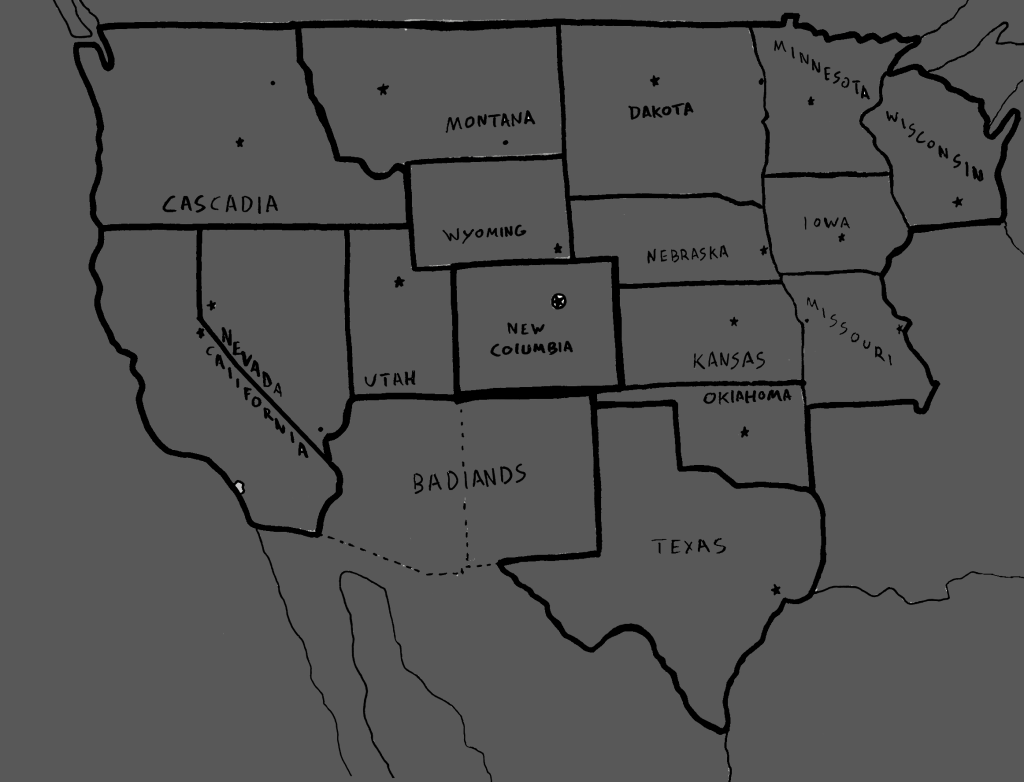
During the War against the AI, Alliance forces stretched out across the Western and Midwestern regions of the former United States restoring order. After the war, the reformed states were bolstered by added support from various sources, mainly the nationalized agriculture system defended by Alliance forces. TeraCom invested in the Sovereign State’s market growth, fields were tilled, and crops were planted across the plains and valleys. In the years following the Blackout, the power came back and normality returned. Most of the former United States was reshaped into what became The Sovereign States. Dakota, Utah, Nevada, California, Oklahoma, Nebraska, Kansas, Iowa, Montana, Wyoming, Minnesota, Wisconsin, Missouri, New Columbia, Texas, and Cascadia make up the entirety of The Sovereign States.
The Badlands, formerly Arizona and New Mexico are loosely patrolled by Alliance forces that defend minor trade routes running through the region. Aside from a few small towns and homesteads, the area is almost entirely lawless.
Texas
Texas and Cascadia are the only Sovereign States that maintain their own military forces. While other states are defended by Allied Forces by order of the Continental Congress, Cascadia and Texas maintain greater levels of independence. These states took it upon themselves to secure their own borders.
Texas has become one of the most secure states in the union. The Texas Rangers defend their state with strict adversity. They take a direct hand in supporting Highway Patrol activities. Allied forces stationed here have been regulated to border patrol, which typically translates to stopping and informing travelers that they are about to enter Texas.
Denver DC
The capital of the young nation that is The Sovereign States is sat in Denver, District of Columbia. It also serves as the capital of the Sovereign State Commonwealth of New Columbia. New Columbia is not technically a state but a “District of Columbia” and is managed by the Continental Congress and Alliance Forces directly.
In the years following the Blackout, Denver has seen economic growth and a modest resurgence of its large industrial facilities. After Denver was liberated by Alliance Forces, the city’s abandoned factories were refitted to support Alliance military needs, leading to a rise in the area’s prosperity immediately. Once the war was over, manufacturing plants were repurposed for various home and commercial commodities allowing the city to continue to grow and thrive.
The factories in Denver were reshaped by the Alliance but after the war, the nationalized grip was released. Most factories were sold in public markets, allowing Denver to grow and offer multiple independent labor opportunities.
Alliance HQ
Deep in the mountains of New Columbia sits the continent’s most secure military complex. Formerly, the largest aerospace defense network, once known as NORAD. this is where the battalion of soldiers that formed the Alliance made contact with OSCAR.
Due to the station’s excellent defensive capabilities and abundance of unused armaments, the base is still used today by Alliance Forces. The area is referred to by Alliance soldiers as HQ, Headquarters, or simply “The Mountain”.
New Angeles
New Angeles rose from the ashes of Los Angeles, Long Beach, and various other pre-blackout cities. Still the home of high-speed pursuits and suburban sprawl. New Angeles sports a slightly different look than from the past, mangled wrecks of vehicles liter the freeways while others fight and shoot their way across the road. Ok, well maybe it’s not that different than before.
The neighborhoods below the freeways are mostly calm, ripe with settlers and survivors. Though many old buildings are dilapidated and in need of repair, revitalization efforts are making consistent progress. The UPN has a strong presence in the area and manages the city. Though still part of the Sovereign State of California, New Angeles governs itself independently. The city also maintains a TeraCom Central Bank and has multiple dispersed TeraCom economic zones. The area has been using the TeraCom Credit system since agreements were made between The Sovereign States and TeraCom in 2021.
The Steel City
West of TeraCom City, buried in the Rustlands, on the edge of the Holler, lays The Steel City; Pittsburgh. The city has always been a hub of the steel industry and headquarters of one of Earth’s largest producers of iron and steel, US Steel. The name “City of Steel” has been used for decades. After the Blackout, it has become an unofficial title.
The City of Steel is surrounded by thick brush and polluted woodland areas on all sides, with the Alleghany Mountains to the Southeast. The center of the city is in between the meeting point of three heavily polluted rivers that have been known to catch fire frequently. Spanning the toxic rivers are new illustrious bridges constructed by the Carnegie Society. Since the Renaissance of The Steel City, the area has become a postmodern portrait of elegance, beauty, and overwhelming filth.
Salvation
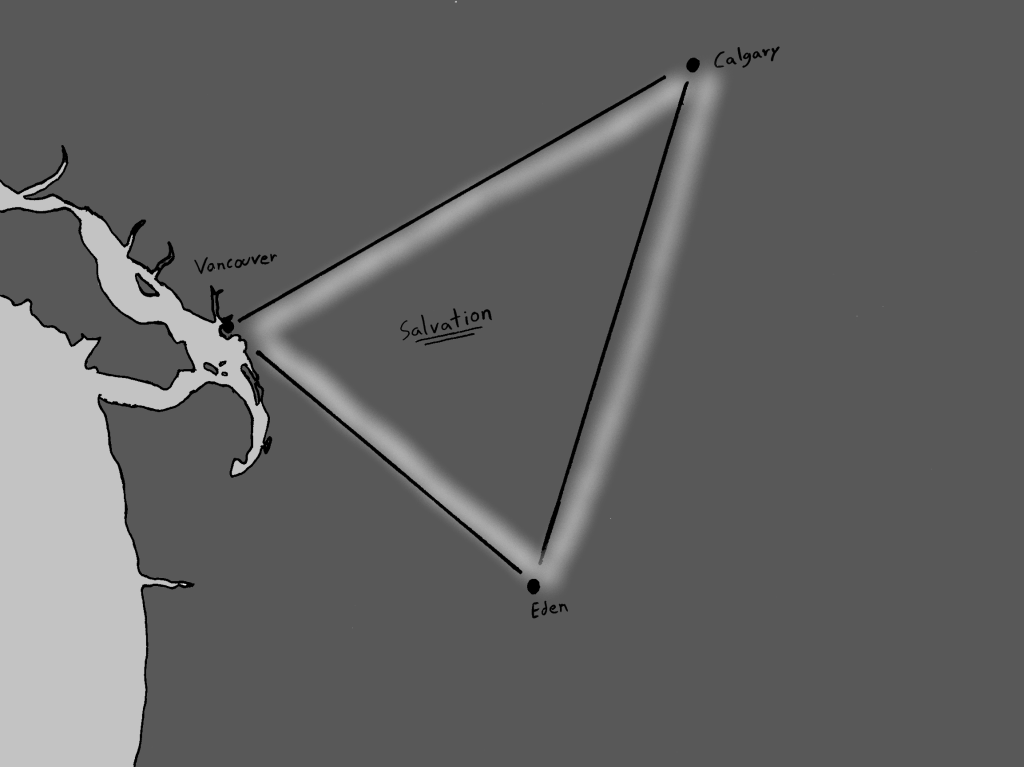
Deep in the wastes of the Pacific Northwest, now the Sovereign State of Cascadia, beats the heart of Salvation. Far from the bullets and blades of Hunter Corps patrols. Refugee Auts have found sanctuary. In the ruins of the Hanford site, cradled by the toxic air, the refugees found their providence. The Auts of Salvation knew they would be shielded by the blight. The rotting factories that housed the world’s first industrial reactors for refining plutonium sat harmlessly in the prairie. Since the Blackout, the region had succumbed to its radioactive skeletons buried beneath the dust. No Humans can come within miles of the Hanford facility or the river that flows through it, without proper protection.
The Auts were safe to rebuild. From here, future generations of Auts spread out further north. Some heading towards the harsh wetness up the coast, while others made trails through the cold arid plains. In Canada, in the remains of the major cities, The Auts found places for themselves. In the ruins of Vancouver, Auts hide away scattered throughout the crumbling city center. In Calgary, the wandering Auts found safety amongst locals that welcomed them as a bolstering work force. There prosperous Auts work the farms alongside Humans and the animals.
Asteria
A massive space colony in a fixed proximity to the Moon. Asteria was built by Orion Industries with funding from The United States Government as well as some other nefarious organizations. The Colony is technologically advanced far beyond any place on Earth.
Asteria is home to many affluent aliens and some descendants of Earth’s oldest aristocratic human families. Asteria is run by Orion Industries. However, Orion Industries is under new management. Under the authority of The Gruellein Empire and commander Overog, the colony is managed by a group of greedy Corvidian capitalists.
Orion Industries Moon Complex
Built to support Orion Industries technological advancements and developments in space, the base has been repurposed by the Gruellein Empire. The Moon complex is a network of massive sprawling industrial pockets, scattered across much of the moon’s visible surface. The industrial pockets are connected by large above ground tunnel-tube structures. The Gruelleins refer to the complex as Lutoo Lunis.
Thanks to the savvy mercantile skills of the Corvidian backers running Orion Industries, 90% of the goods produced on the Moon and Asteria are sold across multiple galactic markets. The elaborate complex is home to hundreds of thousands of Org servants and their families who run and maintain the lunar facilities. This prison satellite is their entire world. The only way to access the Moon complex from Asteria is a single industrial transport station that can shuttle individuals between the moon base and space colony. All other lunar travel is handled at various intergalactic shipping and receiving docks. All these areas are heavily guarded by Gruellein Empire personnel.
The Valley of the Shadow
In the abandoned ruins around San Francisco Bay, you will find nothing but destruction and waste. On the southern part of the bay is a region once known as Silicon Valley. This area housed some of the most advanced technological facilities Earth had to offer. High-end apartments and office buildings dotted the landscape. Now all that’s left is the skeletal remains of once great cities; the ruble left behind from the hellfire eradication.
In the early days of the war, after the Modesto firestorm, OSCAR turned this region into its physical epicenter. Old robotics manufacturers and assembly lines were reprogramed to serve as the AI’s limbs. It didn’t take long for robotics projects to be redesigned further by the digital intelligence. The first Auts were born.
During the war to shut down the AI, the region was ravaged by fighting. All that’s left now of San Francisco and San Jose is ruble. Locals hold strong reservation regarding the area. Superstitions say the ruble is cursed, haunted by the ghost of the digital intelligence. Some who have traveled through the wreckage of the old cities claim to have seen something strange. Something that follows travelers from the shadows. They say it is shaped like a man. Others have witnessed a glowing red eye peering out from the darkness in the night; It moves but it doesn’t blink.
The Wastes
“The Wastes” is a term used to refer to the unmanaged lands in between the cities and industrial complexes. There is no one region or area that defines the wastes. There are a multitude of toxic wastelands, each offering their own personal charm.
The Holler
Once you travel south from the Rustlands you hit the radioactive hills of the Holler.
Thick brush, old farmlands, hills and forests make up this sparsely populated region. The area has been mostly reclaimed by nature. A few different groups still call the Holler home. They share the land with strange creatures and supernatural beings.
The Rustlands
As the thick hilly forests of the Holler spread into the Northeast, the wooded landscape begins to change. The bitter northern landscape is adorned with pine trees. Small, abandoned towns of pointed roofed houses garnish this deeply polluted area. Factories, mills, foundries and freightliners, are all left to rot along the side of the overgrown roads since the Blackout.
The regions former dependency on atomic energy has left most of the Rustlands extremely toxic, radioactive, and volatile; even despite TeraCom’s feeble attempts to clean up the area. The Rustlands are plagued with acid rain and roaming clouds of putrid fog that can roast a person’s flesh clean from the bone.
-Restriction Zone-
The Restriction Zone is a massive area spanning what’s left of Washington DC, Baltimore, and most of Virginia. Delaware is not part of the Restriction Zone but is mostly treated as such. Anyone who is familiar with the area will refuses to travel close to the old country’s former capital.
It is unknown exactly why the area is off limits, but it’s said that no one has traveled into this region and returned. What is known, is that the area is completely off limits and entry points from the north are heavily guarded by TeraCom Security checkpoints. No one is granted access. Persistent inquiries about the area can lead to a lethal response from patrolling agents.
 UnnaturalWonderland