TeraCom Security Bootcamp Lesson 2
Alright maggots, now that you’ve got the world figured out, let’s get this shit show on the road. Let’s talk about creating a Player Character. Before we get into hard numbers and brass tacks, we’re going to talk about emotions and feelings. I know, it’s my favorite part too. So, let’s get right into it. As a Player, the first thing you should do is look at “The Trades” and start thinking about your future. Who do you want to be and what kind of character do you want to make for yourself? Don’t make your final decision yet but it is important to have a good idea before the first session. Keep in mind that every Trade has specific stat requirements. Spend points wisely when creating a character.
Once you have the character you wish to create finalized, start filling in your character’s Résumé. Don’t worry about the stats right now; we’ll go over the details afterwards. Start by filling in your character’s, Name, Lifeform, Place of Origin, Natural Ability and Description. Place of Origin may have added benefits by granting player characters certain affiliations and advanced knowledge of a specific area, discuss this with the GM if necessary
Résumé
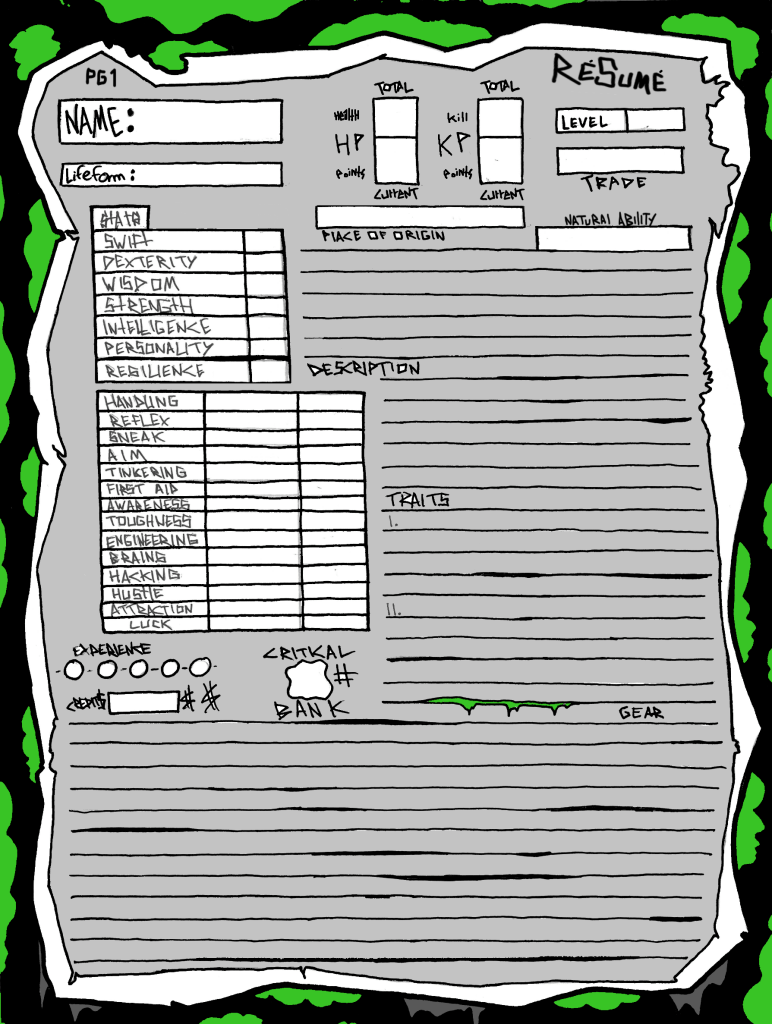
Choosing a Lifeform
Unnatural Wonderland has multiple Lifeforms a player can choose from when creating a character. Each lifeform offers its own set of unique pros and cons related to the current world around them. After you choose a lifeform, you’ll be ready to distribute points and determine your characters starting skills and stats.
Determining Stat Points
All Stats start at 2. You can modify them, but Stats cannot be reduced below 1 for any reason. Likewise, all stats are capped at 11. Distribute 16 points between your Stats but keep in mind that every Trade has specific Stat requirements.
*Example Car Jacker
Requirement: Swift 7, Strength 5
Determining Skill points
All Skills start equal to their corresponding Stat multiplied by 10.
*Example
Dexterity 4 or Dex 4 = Tinkering 4 x10
Tinkering = 40
Swift = Kill Points, Handling, Reflex, Sneak
Dexterity = Aim, Tinkering
Wisdom = First Aid, Awareness
Strength = Toughness, Engineering
Resilience = Health Points
Intelligence = Brains, Hacking
Personality = Hustle, Attraction
Luck for all characters starts at 30
*Luck can be rolled in place of any other skill in a pinch, but the consequences of failure are much more severe.
Tagged Skills
Choose three skills and mark them on your character sheet. When creating a character, add 6 points to each tagged skill. Each time a player fails when rolling a tagged skill, mark experience. Learn from your mistakes.
Leveling Up & Experience
Experience can be gain by a failed tagged skill roll, any critical roll, and when a character does something extraordinary as determined by the GM.
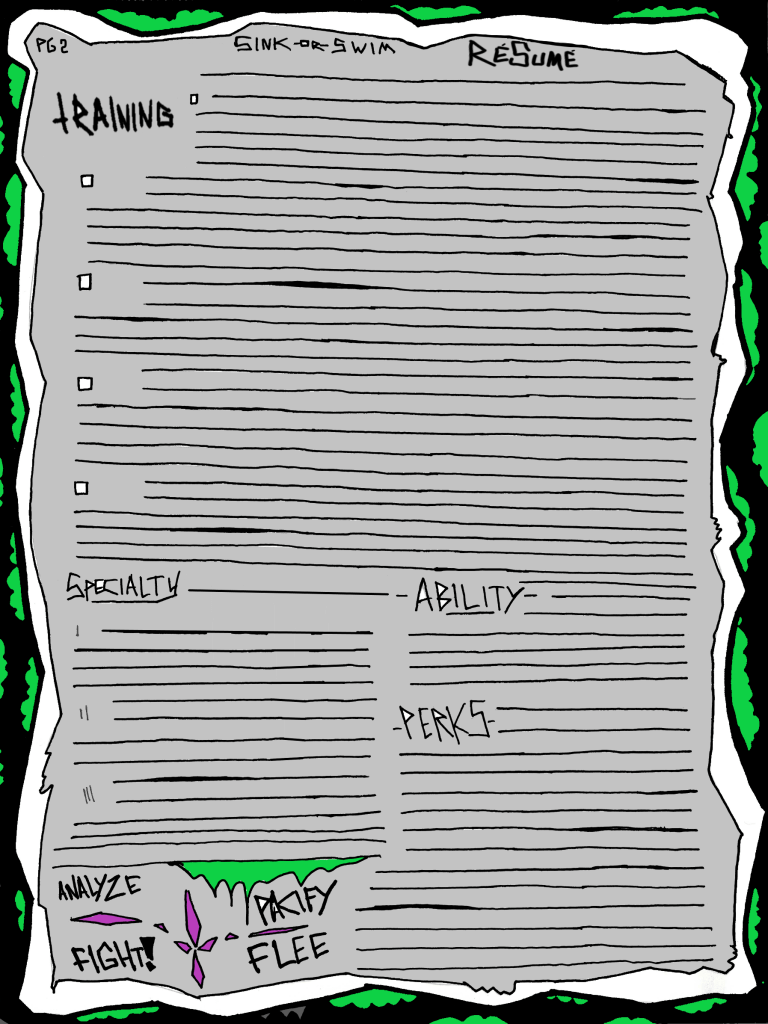
When a character gains 5 Experience, they Level Up. Every time a character Levels Up, they get 6 points to distribute between any of their skills. Also, add 1 Trade Move or 1 Trade Specialty, and add 1 Perk or 1 Advanced Training from their Trade to their Résumé. Perks can be taken indefinitely. Each Advanced Training can be taken once.
Whenever a Stat is increased, add 10 to it’s corresponding skills for every increase by 1.
*Example
Intelligence 6 +1
Brains 64 +10 Hacking 60 +10
Intelligence 7
Brains 74 Hacking 70
Player Characters start the game with 1 Trade Training, 0 Perks, 0 Advanced Training, the first segment of their Trade Specialty, and their Trade Ability.
Trade Specialties (Specialties) are 1 move that is unlocked in 3 segments. Each segment contains its own additional benefits and must be unlocked in a consecutive order.
Health Points
Health Points or HP represents a character’s level of “not dead”. Health Points are the exact amount of damage a character can receive before facing demise.
A character’s Health points or HP is equal to their Resilience multiplied by 4. If a character drops below 80% their total HP in one turn, they will become unconscious temporarily. If a character is ever below 4 total HP, they are unconscious until revived.
*Example
Resilience 6 6×4=24
Health Points = 24
24 x 0.80 = 19.2 If the PC receives 19-20 DMG in one turn they become unconscious.
Kill Points
Kill Points or KP is used to determine how many times a player can use an object or weapon during combat. All weapons have a basic KP cost. Kill Points rejuvenate at the end of every turn.
A character’s Kill Points are equal to Swift plus 3.
*Example
Swift: 8 8+3=11
Kill Points = 11
*Unarmed attacks cost 3KP and the DMG is equal to the character’s total strength.
If this character has a strength of 3, they could potentially punch an opponent 3 times for 3 damage per hit in one turn.
Traits
Traits are specific little modifiers you can add to a character at the start of creation. Choose up to two traits to apply to a character, but they are not required. Traits can have built in side-effects or are otherwise meant to make the character and game more interesting.
*See (15. Traits) for more examples.
Player Inventory
At the beginning of the game Player Characters won’t have much, but as the game progresses, characters naturally start to acquire more possessions. Until the PCs find a safe place to store their things, they will have to keep all their gear on hand. Player Character’s possessions are listed under Gear on their Character sheets. There is no set weight limit but the GM and Players should take into consideration how much stuff their characters could reasonably carry. Once Player’s acquire homes and vehicles, they can store items separately. If a player stores an item in a living Space or vehicle, the item is “Off-Hand” and is not accessible the same as Gear.
Currency
The most common form of currency is TeraCom Credits. Credits can be used to purchase anything from weapons, medical care, food, housing, vehicles, various objects of interest, and more weapons. TeraCom Credits are available both as a paper currency and a debit/credit charge card that can be used to deposit or withdraw credits for safe storage. The charge card is accepted at any major TC distributer or affiliated merchant. 1000 TC Credits equals 1 months’ rent for a single unit in TeraCom city’s most modest accommodations. Other currencies like pre-blackout US dollars are still traded in some areas and communities; various exchange rates may apply.
Prices for commodities are always subject to change based on location, supply, and demand. All prices are set by the GM. Purchasing items can and should result in haggling between the Player and the GM.
 UnnaturalWonderland